
Solutions
Online stores
A store built around what happens after the order: catalogue, checkout, payment, courier and invoicing connected, with measurement inside the product. Defined scope, a published starting price, a date you can plan against.


The problem
Selling online is a shop window bolted to a business that still runs on messages and a spreadsheet. Orders arrive in four places, stock is a guess, invoices are typed by hand, and nobody can see what is actually selling.
The cost of doing nothing
The customer buys from whoever appears in the search result, and that is not you. The orders you do win cost an hour of manual work each, the mistakes reach the customer, and the report exists by the time the month is over.
What we do
We start with what happens after the order. A store is easy to look at and hard to run: the interesting part is what an order sets in motion — stock, packing, the courier, the invoice, the message to the customer, and the record somebody will want to report on next month.
So the catalogue is built around how people choose rather than how the products are filed. Categories follow the decision, the product page carries the objections that would otherwise become a phone call, and checkout asks for what fulfilment needs and nothing more.
Payment, courier and invoicing are connected at launch rather than promised for afterwards. Card and cash on delivery both — in this market a store that offers one of them has decided not to sell to the people who wanted the other.
The store is the deliverable, and it is also the point where the operation becomes visible. What usually follows is automation: the handoffs between production, selling and marketing that are still being done by hand, and then continuous development against what the data starts to show. Those are scoped and priced separately, and they are far cheaper once the store exists.
What is included
-
Catalogue and product data
Products, variants, stock and media in one structure, edited by you rather than by a developer.
-
Categories and navigation
Categories that follow how a customer decides, with filters and search that reach a product in a few steps.
-
Checkout
A short checkout that asks for what fulfilment needs and nothing else, tested on a phone before a desktop.
-
Card payment and cash on delivery
Both, configured and tested, because a store offering only one of them loses the half of the market that wanted the other.
-
Courier integration
Shipments, labels and tracking created from the order, instead of retyped into a courier's own panel.
-
Invoicing
Invoices issued from the order and reaching the customer and your accounts without anyone typing them again.
-
Analytics configured before launch
Measurement in place on day one, so the first month shows what sells rather than how it felt.
-
Technical SEO foundation
Semantic markup, product structure, metadata, sitemap and the performance a crawler needs to index a catalogue.
Proof
Decor Urban (127 products, quote request → email → pre-filled WhatsApp, 75 products in Google Shopping set up by the client), DifferentCut (1,200 customers migrated, 164 products / 1,570 variants imported automatically, a theMarketer feed), Texturra (custom sizes priced live).
Ambalaje Catering (537 products across 80 categories, all 614 old URLs redirected with a 301, a 98/100 mobile Lighthouse score) and Kaira's Legacy Learning (540+ customers moved over from WooCommerce, a platform launched 8 days after the first line of code).
- 537
- Products in the Ambalaje Catering store
- 98/100
- Mobile Lighthouse, Ambalaje Catering
- 540+
- Kaira's customers moved over from WooCommerce
- 8 days
- From the first line of code to launch, Kaira's
Figures from the project audits of Decor Urban, DifferentCut, Ambalaje Catering and Kaira's Legacy Learning, October 2026: catalogue, performance and migration figures, not sales.
-

the home page -
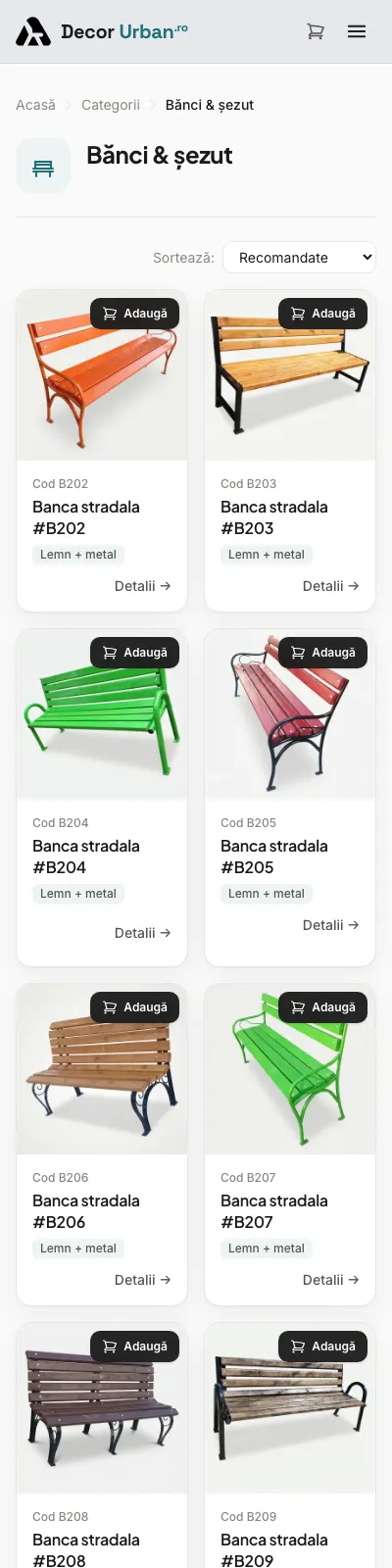
the bench listing -
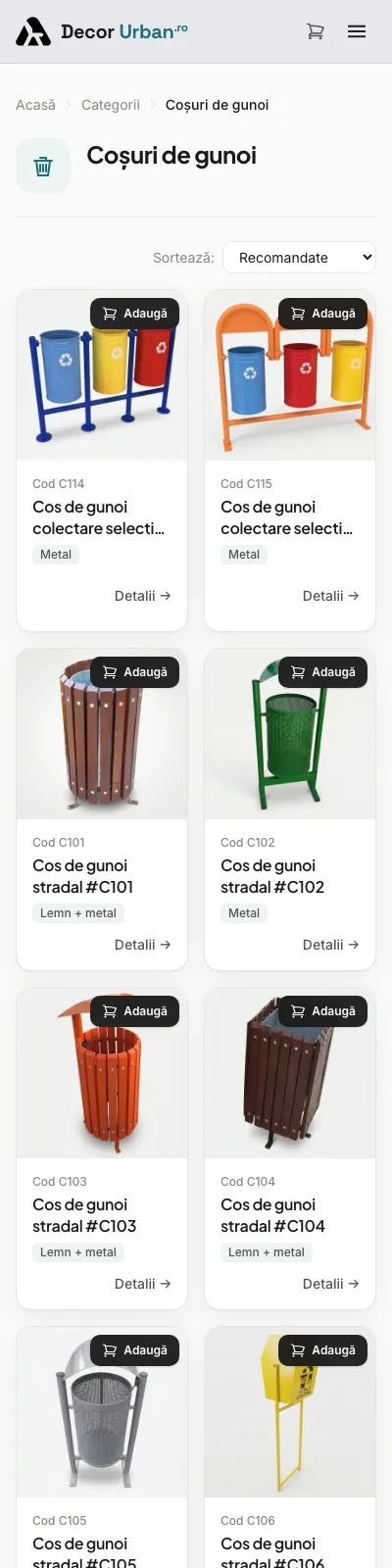
the litter bin listing
Automation
One or two processes people are currently doing by hand, connected to the systems you already run. Defined scope, a published starting price — and usually the cheapest way to find out what a larger system would have to do.
-
One or two processes, mapped
The handoffs as they actually happen today, written down before anything is built — usually the first surprise of the engagement.
-
One or two integrations
Between systems already in use: CRM, invoicing, e-Factura, WhatsApp, email, the spreadsheet everyone depends on.
-
The automation itself
The steps that were done by hand, running on their own, with the rules written somewhere you can read them.
-
Failure handling and alerts
What happens when a system is down or a record is wrong, so a silent failure does not become a month of bad data.
-
Handover and documentation
What it does, where it runs and how to change it, so keeping it working does not depend on us.
-
A map of what is left
The processes we saw and did not touch, each with what it would take. A decision to make, not a call to take.
from 1,500 EUR
The entry threshold for one or two processes and the integrations they need. Anything found on the way is quoted separately and never started without you agreeing to it.
Care & support
A site is a running system, not a delivered file. Monitoring, backups, security and updates, plus an allowance of changes each month — so the thing you paid for still works, and still moves, a year from now.
-
Uptime and error monitoring
Checked continuously, so the alert reaches us rather than reaching you as an email asking whether the site is down.
-
Backups, and restores that are tested
Taken on a schedule and restored from periodically, because a backup nobody has restored from is a hope rather than a backup.
-
Security and dependency updates
Applied on a schedule, with the risky ones staged and checked before they go anywhere near the live site.
-
Performance kept where it launched
Watched across months rather than measured once, so a slow drift is caught while it is still small.
-
An allowance of changes each month
Copy, a page, a form, a price — the small work that otherwise waits a quarter for a quote nobody wanted to ask for.
-
A response time you can hold us to
Agreed in writing and by severity, so a site that is down and a typo are not treated as the same request.
from 250 EUR/month
A monthly retainer rather than a project fee. The included allowance, the response times and what is covered are agreed before it starts, and the site stays yours throughout.
More online stores we've shipped
-
Texturra
Made-to-measure curtains, priced on the spot
-
Ambalaje Catering
537 products, 98/100 mobile Lighthouse
-
Kaira's Legacy Learning
A platform of its own, launched in 8 days
-
Decor Urban
127 products, from “no price” to Google Shopping
-
DifferentCut
1,200 customers migrated, nobody asked to reset anything


Price
The entry threshold for the scope above. Catalogue size, integrations and content production move it, and we say which and by how much before anything is signed.
from 4,500 EUR
Contact